When a donor asks an AI tool about your charity by name (“Is the Red Cross a good charity to donate to?”), your own website does a lot of the talking. When they ask a general question (“What are the best health charities in Australia?”), it usually plays a much smaller part. In our testing, the sources the AI tools leaned on for general questions were mostly other people’s websites, and those are the sites charities tend to think about least.
We saw this clearly in a test we ran in November. We asked ChatGPT, Perplexity and Claude 12 general donor questions, three times each, and also asked whether six well-known charities were trustworthy. Almost every answer listed the websites it used as sources, and those lists tell you a lot about who the tools listen to.
What we looked at
This post uses the same test as our first post in this series, which Australian charities AI recommends. That gave us two kinds of answer:
- 108 answers to general questions, such as the best charities to donate to at Christmas, the best animal charities, or which charity to leave a gift to in a will.
- 36 answers to questions about a specific charity, asking whether it is trustworthy and what the criticisms are. We asked about Australian Red Cross, Cancer Council, RSPCA, The Salvation Army, The Smith Family and World Vision. We chose them because they are household names that donors are likely to ask about, not because of any concern about them.
For each answer we recorded which websites it cited, then grouped those sites by type. We work with some of the charities that appear in these results. None of our client data went into the test.
Asked by name, your website gets a say. Asked in general, it mostly doesn’t.
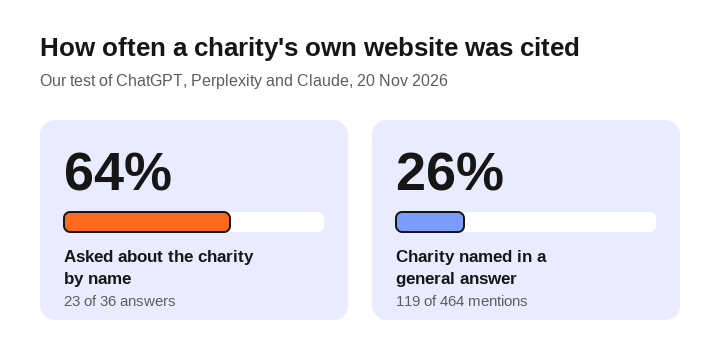
When a tool was asked about a charity by name, it cited that charity’s own website in 23 of 36 answers (64%).
When a charity came up in a general answer, its own website was cited much less often. Across the 108 general answers, one of the 22 best-known charities in our results was named 464 times in total. The charity’s own site was cited alongside it 119 times, about 26%. In roughly three out of four cases, the tool named the charity while drawing on something other than the charity’s own website.
Some well-known charities were named often with their own site barely cited. RSPCA, for example, was named in 32 general answers, and its website was cited in one of them. The tools were getting their information about it from somewhere else.
That’s the key difference. On a question about you, the AI goes looking for you. On a question about which charity to choose, it looks for someone who has already compared charities and trusts their view more than yours.
On general questions, other people’s sites do the talking
These are the kinds of sites cited in the 108 general answers:
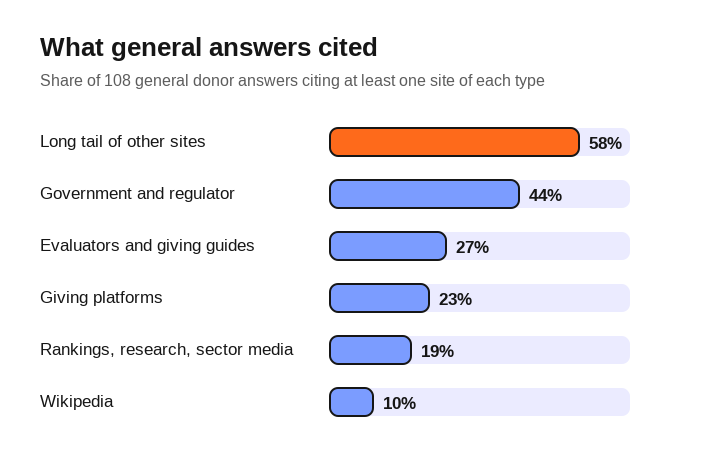
The ACNC register on its own was cited in 44 of the 108 general answers (41%), more than any other website. That makes sense: it is the regulator’s own record, every registered charity has an entry, and the charity keeps it up to date itself through its annual reporting.
Then there is a long tail that surprised us. More than half the general answers (58%) cited at least one site that fits none of those groups. These included an accounting firm’s guide to choosing charities, a will-writing service’s guide to leaving a bequest, a finance comparison site’s Christmas giving article, a regional newspaper’s piece on tax-deductible donations, lifestyle and parenting blogs, and corporate pages describing a company’s charity partners, such as the Petstock Foundation’s partner page. None of them are charities. They were written for people, not for AI, and they mentioned charities in a useful, specific context. The AI picked them up anyway.
For a charity, that long tail is good news. It means there are many more places that can vouch for you than the handful of big rankings.
When your own site does get cited, it’s for one specific page
Charity websites weren’t absent from general answers. In 41 of the 108, the tool cited the own website of at least one charity it named. When we looked at which pages were cited, they were mostly pages that answered the exact question being asked, rather than home pages or about pages. Some examples:
- For the tax time question, the tools cited Oxfam’s page on tax-deductible donations and its donation tax calculator, and Caritas Australia’s tax appeal page.
- For the monthly giving question, they cited Caritas’s monthly giving pages and UNICEF Australia’s page on becoming a monthly donor.
- For the question about which charities a company should partner with, they cited UNICEF Australia’s corporate partnerships page and Make-A-Wish Australia’s partner page.
What these pages have in common is that each answers one question a donor actually asks, and nothing else. We cover this in detail in the charity pages that turn visits into donations, because it is one of the few things a charity can fix entirely on its own site.
The best of those pages repeat what others say about you
One more pattern stood out. Several charity pages cited for “most trusted” or “best children’s charity” questions were pages where the charity restates a third-party result about itself. Australian Red Cross has a media release about being named Australia’s Most Trusted Charity Brand at the Roy Morgan Trusted Brand Awards. Make-A-Wish Australia has a page titled “Australia’s Most Trusted Children’s Charities”. St John Australia has a page about being one of Australia’s top five most trusted charity organisations.
In each case the proof came from someone else, and the charity gave it a clear, dedicated page. The tools could cite either source, and in our test they cited both. That is a simple, repeatable step: when an independent body rates, ranks or awards you, publish it on its own page with a plain headline, and link to the original.
Asked by name, the reviews start to matter
The picture changes when a donor asks about your charity directly. The charity’s own site was cited in most of those answers, but so were reviews and forums. Review sites and forums such as Reddit, Trustpilot and ProductReview were cited in 15 of the 36 trust answers (42%), compared with 3 of the 108 general answers (3%).
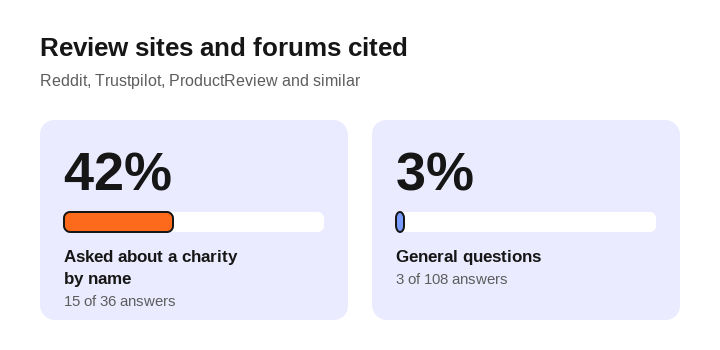
So the sources that decide whether you’re recommended are different from the sources that decide how you’re described. We look at the second group, and what you can do about it, in what AI says about your charity when a donor asks.
What to fix first
If you’re responsible for how your charity shows up, these are the places we’d start. They’re roughly in order of effort. (For how we approach this work for not-for-profits, see SEO for not-for-profits.)
Your ACNC register entry. It was the most cited site in our test. Your entry shows the programs you report in your Annual Information Statement, including what each one does, who it helps and where it runs, and you can list up to 10. Make each program description specific enough that a tool could match it to a donor’s question.
A page for each giving question. Tax-deductible giving, monthly giving, gifts in wills, corporate partnerships, where the money goes. If a donor asks it, there should be one page on your site that answers it plainly.
A page for each independent result. Awards, rankings, evaluator ratings and survey results, each on its own page, with a clear headline and a link to the source.
Your evaluator and directory profiles. If an evaluator, giving guide or giving platform covers your kind of work, check what it says about you and keep it current. Not every charity will be covered by every evaluator, and that’s fine. The ones that cover your cause are the ones that matter.
Your partners’ pages. Corporate partners, foundations, councils, universities and other charities often mention you on their own sites. Check what they say. Ask them to describe the partnership in a sentence or two, with a link to you, rather than just showing your logo.
What takes longer
Some of what the AI tools relied on can’t be fixed in a week. Coverage in news and sector media, a place in independent rankings and surveys, and mentions on the kinds of sites in that long tail all come from being useful and visible over time.
You can make that more likely. Give journalists and sector media something specific to report, such as your own data, a clear explanation of a policy change, or results from a program. Make it easy for accountants, will services and community sites to describe you accurately by having plain pages they can link to. And make sure your partners know how to talk about you.
How to measure it
Every quarter, ask the same set of donor questions in ChatGPT, Perplexity, Claude and Gemini, three times each. For every answer, note two things: whether your charity is named, and which websites are cited as sources.
Over a few quarters, the sources column tells you more than the mentions column. It shows you which third-party sites the tools trust for your cause, which of them mention you, and which mention your competitors instead. That’s your list of where to work next.
If you’d rather not run this yourself, our free AI visibility check does it for you and shows which sources the tools rely on for your charity.
Limits of this test
This was one test, on one day, in three tools, so treat these numbers as a snapshot rather than a law. We grouped websites by type ourselves, and some sites could fit more than one group. ChatGPT and Perplexity cited sources in all of their general answers, while Claude cited sources in 29 of its 36, so Claude contributes a little less to the source counts.
We can show which sources the tools cited. We can’t prove that improving any one of them will get a charity named more often, and we haven’t measured how often each charity is mentioned across the wider web. Treat the advice here as the sensible response to what the tools relied on, not a guaranteed formula.
Larger charities also have a head start: more partners, more coverage and more people writing about them. A smaller charity is unlikely to match that across every question, which is why we’d focus on the specific questions where you can be the clear answer.