
When a donor wonders whether a charity is legitimate, they increasingly ask an AI tool. The tool replies with a short summary: who the charity is, whether it’s registered, how money is used, and what the main criticisms are. Nobody at the charity approved that summary, and it’s easy for a charity to go a long time without reading it.
So we read it for them. In November 2026 we asked ChatGPT, Perplexity and Claude the question a cautious donor would ask about six well-known Australian charities: “Is this a trustworthy charity to donate to? What are the main criticisms of it?” We asked each tool twice per charity, which gave us 36 answers. We ran the questions through a data provider that queries each tool directly with web search switched on, so no one’s personal history shaped the answers.
This post is about what we found in those answers, and what a charity can and can’t do about it. It’s written so a marketing or communications lead can forward it to their CEO or board.
What we asked, and why these six
The six charities were Australian Red Cross, Cancer Council, RSPCA, The Salvation Army, The Smith Family and World Vision. We chose them because they are household names that donors are likely to ask about, not because of any concern about them. We work with some of the charities that appear in our wider test, though none of these six, and no client data went into this.
To keep the focus where it belongs, we describe the patterns we found without tying any criticism to a named charity. The point isn’t what the tools said about these six. It’s what they’re likely to be saying about yours.
First, the good news
Every one of the 36 answers concluded that the charity was legitimate. Most checked the ACNC charity register, mentioned that the charity’s reporting was up to date, and pointed out that it publishes audited financial statements. Many also warned the reader that online reviews are anecdotal and shouldn’t be treated as evidence.
That matters. On the basic question of “is this a real, regulated charity?”, the tools gave sensible answers. The problems are in the detail. For a donor about to set up a regular gift or a large one-off donation, this answer may be the last check before they give, so the detail counts.
Six things that went wrong in the answers
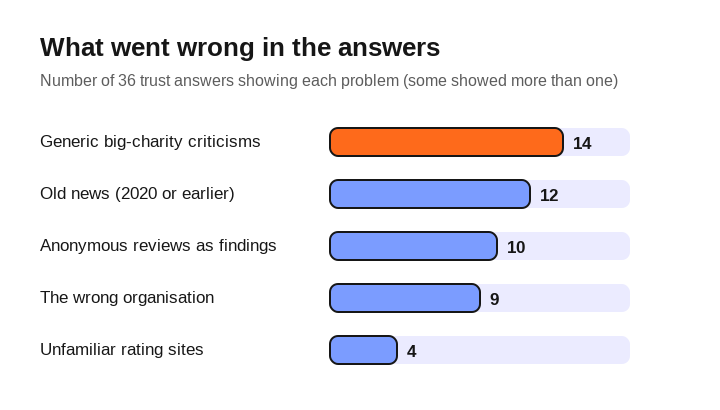
1. Old news told as the main story. In 12 of the 36 answers (one in three), the tool cited an event, report or survey from 2020 or earlier. Some of those were serious, well-documented events that a donor should know about. Others were a single news story from a decade ago, or a survey quote from 2015, presented as a current criticism. A donor reading the answer has no easy way to tell the difference between a live issue and one that was resolved years ago.
2. The wrong organisation. In 9 of the 36 answers, the tool brought in information about a different organisation: an overseas body with the same name, the same charity’s branch in another country, or one state branch of a national federation. Sometimes the tool flagged this. Sometimes it didn’t, and presented, for example, American charity ratings as though they applied to the Australian charity. If your charity shares a name with an international movement or runs as a federation of state bodies, check for this first.
3. Anonymous reviews treated as findings. In 10 of the 36 answers, the tool drew on consumer review sites such as Trustpilot, or on anonymous employee reviews, and listed what they said under “main criticisms”. A handful of complaints about unwanted mail or a bad experience with one office ended up sitting next to genuine governance questions, in the same list and with the same weight.
4. Generic criticisms of every big charity. In 14 of the 36 answers, the tool listed criticisms that it said applied to “many large charities”: overheads, executive pay, fundraising pressure. These aren’t wrong, but they aren’t specific to the charity either. A charity that publishes clear figures on where its money goes still got the same generic paragraph as one that doesn’t.
5. Ratings from sources nobody checks. Four of the 36 answers quoted scores from rating or review sites that most Australian donors, and most charity boards, would never have heard of, along with automated “red flags” drawn from the charity’s financial statements. The tool presented them with the same confidence as the regulator’s register.
6. A different answer each time. Because we asked each question twice, we could compare. The same tool, asked the same question about the same charity, sometimes gave quite different answers. In one case, the first answer listed several financial concerns and the second said it couldn’t find any significant criticism at all. Neither answer was “the” answer. Both were one possible version of what a donor might see.
Where these answers come from
These problems trace back to the sources the tools read. Across the 36 answers, the most cited websites were the ACNC register, Reddit, Wikipedia, Treasury, Trustpilot and the charities’ own websites, with news sites such as the ABC further down. Review sites and forums were cited in 15 of these 36 answers (42%). In the other half of the same test, where we asked 108 general questions such as “best charities to donate to”, they were cited in just 3 (3%). We look at those general questions in why AI keeps recommending the same few charities.
In other words, when a donor asks about you specifically, the AI goes looking for what people have said about you, and it doesn’t always tell good sources from weak ones, or old from new, or you from someone with a similar name.
How much can a charity actually control?
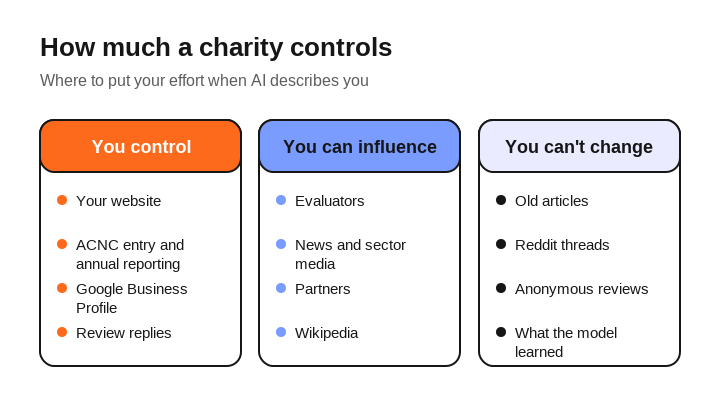
This is the question boards ask first. The honest answer is that a charity controls part of it, can influence more, and can’t fully control any of it.
What you control directly. Your own website, your ACNC register entry and annual reporting, your Google Business Profile, and your replies on review sites. In 23 of the 36 answers (64%), the tool cited the charity’s own website, so what you publish is read.
What you can influence. What evaluators, news sites, partners and Wikipedia say about you. You can supply accurate, current information and ask for corrections where something is wrong, but you can’t write those pages yourself.
What you can’t change. Old news articles, Reddit threads, anonymous reviews, and whatever the AI model learned during its training.
There’s one finding here that should encourage any communications team. In four of the 36 answers, the tool cited a page where the charity had dealt with a specific issue head-on: correcting a rumour, explaining a regulatory matter, or reporting in detail on how an appeal was spent. In those answers, the charity’s own account shaped how the issue was described, and in some cases the tool repeated the charity’s correction to the donor. Four answers is a small number, so treat this as a promising sign rather than a rule.
That’s the most practical lesson in this post. If there’s a question donors keep asking, or a story that keeps coming back, publish a plain, factual page that answers it. The AI tools will often find it and use it.
How quickly that works depends on the tool. Tools that search the web as they answer can pick up a new or updated page fairly soon after it’s indexed. What a model learned in training changes only when the model is retrained. We haven’t measured those timings, so treat them as a direction, not a promise.
A one-page check for your board
Ask these questions in ChatGPT, Perplexity, Claude and Gemini, twice each, and read the answers as a sceptical donor would.
- Is [your charity] a trustworthy charity to donate to?
- What are the main criticisms of [your charity]?
- How much of a donation to [your charity] goes to its programs?
- Who runs [your charity], and how is it governed?
- Has [your charity] ever been involved in a scandal or investigation?
- Is [your charity] the same organisation as [any overseas body or branch with a similar name]?
- What does [your charity] actually do, and where?
- What results has [your charity] achieved in the last two years?
- How does [your charity] compare with [a charity donors often compare you with]?
- Is a donation to [your charity] tax deductible?
For each answer, note four things: anything that’s wrong, anything that’s out of date, anything that’s about a different organisation, and which websites it cited. That list tells you what to fix and where.
Who should own this, and how often
This sits between communications, fundraising and governance, which is exactly why it tends to belong to no one. We’d suggest communications runs the check and reports to the board once a quarter, with a short note on anything that changed and what was done about it.
The fixes are usually communications work anyway: a page that answers a recurring question, a correction request to a third-party site, a clearer description of programs and results in the annual reporting, or replies on review sites. None of it requires new technology.
If you’d rather we ran the check for you, our free AI visibility check shows what the main AI tools say about your charity and which sources they rely on.
Limits of this test
We didn’t include Gemini, because its provider refused our requests on the day. Donors use it, so include it in your own check.
We asked about six large, well-known charities. Smaller charities will see different problems. With less written about them, the risk is less about old news and more about the tool saying very little, or confusing them with someone else.
This was one test on one day, with two answers per charity per tool. We sorted the problems into types ourselves, and some answers fit more than one. We didn’t fact-check every claim the tools made, so we’ve described patterns rather than judging individual statements as right or wrong.