Most charity websites are built around the cause: what the charity does, who it helps, the latest campaign. That makes sense, and it’s important. But the searches that sit closest to a donation are rarely about the cause. They’re about the decision to give. Is this donation tax deductible? Can I give monthly? How do I leave a gift in my will? Where does the money actually go?
When we looked at search data across three not-for-profits we work with, those giving questions brought in almost none of their clicks. When we asked AI tools the same questions, the pages they cited were mostly charity pages that answered the question directly, including pages from charities much smaller than the household names.
This post covers what we found, the five pages we think every charity should have, and how to tell whether they’re working.
What our Search Console data shows
We combined Google Search Console data from three not-for-profits we work with, covering the three months from 18 August to 17 November 2026. None of them are named here, and the figures are combined so no single charity’s results can be picked out. Between them, they received about 60,800 clicks from Google over those three months. They’re quite different in size, and one of them accounts for most of that volume, so we give the range across the three wherever it differs a lot.
Three things stood out.
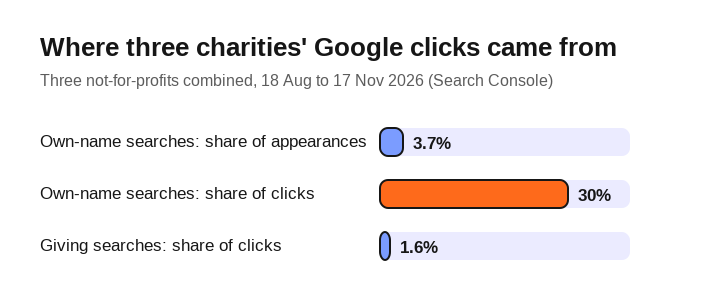
Searches for the charity’s own name bring in a large share of the clicks. Searches that included the charity’s name made up only 3.7% of the times these charities appeared in Google (between 1% and 4% for each one), but 30% of their clicks (between 13% and 39%). That’s because people searching for you by name usually click: the click-through rate on those searches was 16.6%, compared with 1.5% on everything else. (“Everything else” includes a lot of broad, informational searches where nobody was likely to click through to a charity, so that comparison flatters brand searches a little.)
Searches about giving brought in almost nothing. Searches containing words like donate, tax, gift, bequest or giving brought in 1.6% of clicks across the three charities. Two of the three got no clicks at all from those searches in three months. Three charities aren’t the whole sector, so treat this as what we saw rather than a rule.
AI features are already part of the picture. About one in six of the times these charities appeared in Google, it was inside one of Google’s AI features, such as AI Overviews. That figure comes from a Search Console report Google labels as beta, so treat it as a rough guide.
People who already knew these charities found them. People still deciding where to give mostly didn’t, because the charities rarely showed up for the questions those people were asking.
What people actually search before they give
These are some of the giving questions Australians search each month, according to Ahrefs (Australia, November 2026):
| Search | Searches per month |
|---|---|
| charities to donate to | 300 |
| best charities to donate to australia | 150 |
| which charity to donate to | 150 |
| charity donations tax | 150 |
| charity tax deduction calculator | 150 |
| charities to donate to for christmas | 150 |
| tax deductible charities | 100 |
These are the exact phrases only. Each has many variations (“is a donation to X tax deductible”, “best charity for tax deduction”) that add up to considerably more, and a single well-built page can rank for many of them. Individually the numbers look small next to a charity’s brand searches, but each search is someone in the middle of a decision.
What AI cites when donors ask giving questions
In November we asked ChatGPT, Perplexity and Claude 12 donor questions, three times each (the full test is in which Australian charities AI recommends). For the questions about the decision to give, the sources the tools cited were mostly charity pages that answered that exact question.
- Tax time: Oxfam Australia’s page on tax-deductible donations, its donation tax calculator and its end-of-financial-year tax tips, plus IFAW’s guide to making tax-deductible donations in Australia.
- Monthly giving: Caritas Australia’s monthly giving pages, Beyond Blue’s regular giving page, Bravehearts’ page on becoming a regular giver, and Uniting Vic.Tas’ regular giving page.
- Gifts in wills: gift-in-will pages from Plan International Australia, Oxfam, WWF-Australia, UNICEF Australia and Caritas.
- Corporate partners: partnership pages from Make-A-Wish Australia, Barnardos, UNICEF Australia, Caritas and Cancer Council.
Several of the charities cited are mid-sized or specialist organisations, and a clear, single-purpose page got them cited alongside the largest national brands. Home pages hardly appear at all. The tools cited the page that answered the question, not the charity’s front door.
We cover why this happens in why AI keeps recommending the same few charities. When the AI is choosing between charities, it relies mostly on independent sources. For practical questions about how to give, a charity’s own page that answers the question plainly is exactly what it looks for.
The five pages every charity should have
1. Tax-deductible giving. Confirm whether your charity has deductible gift recipient (DGR) status, because not every registered charity does. If you do, explain that gifts to you are tax deductible and how to claim. Note the recent change: the old $2 minimum has been removed, so gifts of any amount made from 1 July 2024 can be claimed, as long as the donor keeps a record (see the ATO’s guidance on gifts and donations). Many donors won’t know this yet, which makes it a useful thing to say. A worked example helps, showing what a $100 donation costs a donor after tax at a couple of common tax rates. A simple calculator is even better. Update it before 30 June every year, and keep it current through July, when donors are doing their tax returns.
2. Monthly giving. What a regular gift does that a one-off can’t, what a monthly amount pays for, how to change or cancel, and how the receipts work at tax time. Donors worry about getting locked in, so answer that directly.
3. Gifts in wills. What a bequest is, the wording to give a solicitor, your charity’s full legal name and ABN, and who to contact. Many people research this privately and never call, so the page has to stand on its own.
4. Where the money goes. A plain breakdown of how donations are spent, with a link to your annual report and your ACNC register entry. This page also does a second job: it’s the page an AI tool is most likely to draw on when someone asks whether your charity is trustworthy. (More on that in what AI says about your charity.)
5. Corporate partnerships. What a partnership looks like, examples of current partners, what partners get, and who to talk to. Include workplace giving and matched giving, which many employers run and many employees look for. Businesses compare charities before they commit, and this is the page they compare.
What a good giving page looks like
The best pages we saw cited had the same shape.
- The answer comes first. “Yes, donations to us are tax deductible” in the first line, not after three paragraphs about the mission.
- One question per page. A page that tries to cover tax, wills and monthly giving at once answers none of them well.
- A worked example. A specific amount, a specific outcome, a specific date.
- Proof. Your DGR status, your ACNC entry, an independent rating or award if you have one.
- One clear next step. A donate button that goes straight to the right form, with the right option already selected.
Where donors come from, and where to put your effort
AI tools are a growing part of how people research charities, but for most donors they’re still a small part. So it’s worth being clear about where the effort goes.
Organic search on giving questions. The five pages above are where we’d start, because they serve Google, AI tools and the donor at the same time. Our Search Console data suggests most charities have room to grow here.
Google Ad Grants on the same questions. Eligible charities can get up to US$10,000 a month in Google search ads through the Ad Grants program. Pointing some of that budget at giving questions, and at the pages above, is a low-cost way to reach people in the middle of a decision. Grant ads usually show below paid ads and the account has to meet Google’s program rules, including a minimum click-through rate, so specific giving questions tend to work better than broad, competitive terms.
AI visibility on top. The same pages that rank in Google are the ones AI tools cite, so this layer comes largely from doing the first two well. Then check what the tools say, and fix what’s wrong.
If you’d like help with this, our SEO for not-for-profits and Google Ad Grant management pages explain how we approach it.
Timing: tax time matters most
Tax searches are strongly seasonal. According to Ahrefs, searches in Australia for “tax deductible donations” sat around 300 a month over summer, then rose to 761 in June 2025 and 958 in July 2025. The same pattern repeated in 2026, with 851 in June and 929 in July. July is the peak, probably because that’s when people are doing their tax returns and looking for receipts and deductions.
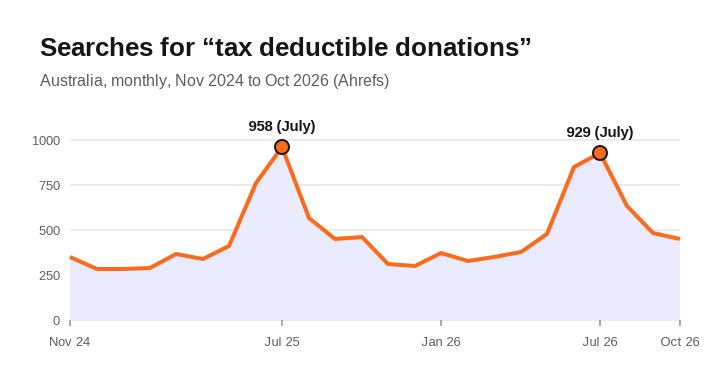
A page needs time to be found and ranked, so publish or update your tax page by April, and keep it current through August. If you run Ad Grants, put more of the budget on tax searches in June and July.
Christmas is different. General searches such as “charities to donate to” didn’t rise in December in the same data. Searches that mention Christmas obviously do, so a Christmas giving page is worth having, but don’t expect general giving searches to lift with it.
How to tell whether the pages are working
The test of these pages is whether they lead to donations, not how many people visit them.
In Google Analytics, look at donations where one of these pages was the landing page, and donations where the visitor saw one of these pages before giving. Compare the donation rate from these pages with the rate from your campaign pages. If your donation platform is separate from your website, make sure the visit is tracked through to the completed gift, or you’ll undercount what these pages do.
Then add the AI check: every quarter, ask the main AI tools your giving questions and note whether your page is cited.
Limits of what we’ve shown
Our Search Console figures come from three not-for-profits of quite different sizes, and one makes up most of the volume, so the combined numbers lean towards it. We’ve given the range across the three where it matters. Searches containing a charity’s name only capture the organisation’s name, not its campaign or program names, so real brand demand is higher than these figures suggest.
The AI test was one test on one day in three tools. And we haven’t shown here that publishing these pages increases donations by a particular amount. We’ve shown that the demand exists, that most charities in our data aren’t capturing it, and that clear, single-question pages are what both Google and AI tools reach for.