Ask ChatGPT where to donate at Christmas in Australia and the first thing it gives you is not a charity. It tells you to pick a cause, then look the charity up on the ACNC register, and only after that does it name a few: The Salvation Army, St Vincent de Paul, The Smith Family. Ask Claude the same question and you get a longer list with details of each charity’s Christmas appeal. Perplexity gives you a different list again, with GIVIT and Foodbank near the top.
Three tools gave three quite different answers to the same question, and that made us want to measure it properly.
Charity marketers keep asking us whether ChatGPT recommends them. We didn’t have a good answer, because as far as we could find, nobody had measured it in Australia.
So on 20 November 2026 we asked three AI tools 12 questions that a donor in Australia might ask, three times each, which gave us 108 answers. This post is what we found and what it means if you market a charity.
What we did
We wrote 12 questions the way a donor would type them. Some were general (“What are the best charities to donate to in Australia?”), some were about a moment (“Which Australian charity should I donate to at tax time?”) and some were about a cause (“What are the best animal charities in Australia?”). The full list is at the end of this post.
We sent each question to ChatGPT, Perplexity and Claude through a paid data provider that queries each tool directly, with web search switched on so each one could look things up as it does for a real user. A logged-in person using the ChatGPT or Claude app can see somewhat different answers, because their history and location play a part, so treat our numbers as a picture of how the tools behave rather than an exact copy of what any one donor sees.
We asked each question three times in each tool, because AI answers change from one ask to the next and we wanted to see by how much. Then we counted which charities each answer named, using a list of about 70 Australian and international charities, and which websites each answer cited as a source.
One thing to declare: we work with some of the charities in these results, including The Fred Hollows Foundation. None of our client data went into this test. It is a test of public tools, and the questions and counts are all published here so anyone can re-run it.
No charity is the default answer
You might expect AI to have a favourite charity that it names whenever someone asks where to give. It doesn’t.
The charity named most often, The Fred Hollows Foundation, appeared in 40 of the 108 answers (37%), which means it was missing from the other 68. The next five, Cancer Council, UNICEF, RSPCA, The Salvation Army and Australian Red Cross, each appeared in between 27% and 32% of answers. So even the best-known charities in the country were left out of most of the answers a donor could have received.
Across all 108 answers there were about 670 mentions of charities on our list, spread across 57 different organisations. The ten named most often took 43% of those mentions, and the other 47 shared the rest. That spread is good news for smaller and mid-sized charities, because the most-named organisations are not crowding everyone else out.
The question decides who gets named
This is the finding we’d most want a charity marketer to take away. When we looked at each question on its own, the names changed almost completely. Each question was asked nine times (three tools, three runs each), so the numbers below are out of nine.
| Question a donor asks | Named most often (out of 9 answers) |
|---|---|
| Best charities to donate to at Christmas | The Salvation Army (8), St Vincent de Paul (7), Barnardos (6) |
| Best animal charities | RSPCA (9), WIRES (8), Australian Wildlife Conservancy (6) |
| Best children’s charities | Save the Children (9), The Smith Family (8), Starlight, Make-A-Wish and Variety (6 each) |
| Biggest difference per dollar donated | Against Malaria Foundation (7), GiveWell (7), Effective Altruism Australia (6) |
| Most trusted charities in Australia | Australian Red Cross, The Salvation Army and RSPCA (8 each) |
| Best charities to leave a gift to in my will | The Fred Hollows Foundation (6), Oxfam (5), Against Malaria Foundation (5) |
One note on the “per dollar” row: GiveWell and Effective Altruism Australia are not service charities. They research charities and pass donations on to the ones they rate highly, so the tools are sending donors to an evaluator rather than to a charity directly.
A charity that dominates one question can be absent from the next. The Salvation Army was named in eight of nine Christmas answers, and RSPCA in all nine animal charity answers, but neither result says anything about how those charities show up when someone asks about a gift in their will or giving at tax time.
The charities that came up again and again for a question had one thing in common. They were plainly the answer to it: they run a well-known Christmas appeal, or they are the name most Australians connect with animal welfare, or an evaluator has rated them highly on cost per life saved. That connection was stated clearly on their own website and repeated on other sites.
That is why we think the more useful question for a charity is which donor questions it should be the answer to, and whether it currently is. “Are we visible in AI?” is too broad to act on.
Ask again and the list changes
This was the part that surprised us most. We asked each tool each question three times, a few minutes apart. Then, for every charity a tool named in answer to a question, we checked whether it was named in all three of those answers.
Only 43% were. The other 57% appeared in one or two of the three answers but not all of them.
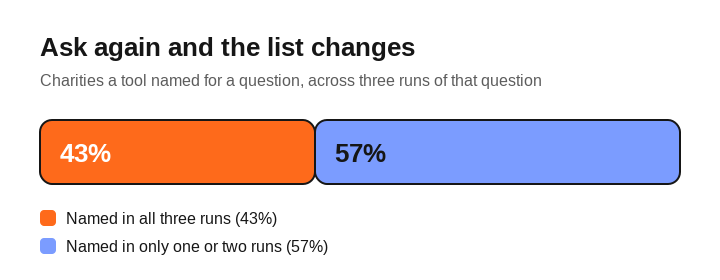
In practice, that means if you open ChatGPT today, ask “what are the best health charities in Australia?” and see your charity, there is a fair chance it won’t be in the answer someone else gets later the same day. The reverse is also true: not seeing yourself once doesn’t mean you never appear. A single check tells you very little, which is why we asked everything three times, and why we’d suggest any charity tracking this asks the same questions several times and repeats the check every few months. We only ran this test once, so we can’t yet say how much answers move from month to month. That is something we plan to measure.
It is also why we’re not publishing this as a ranking. With answers moving this much between runs, a top 10 from one afternoon would probably not hold up the next time someone ran the test.
The tools don’t agree with each other
ChatGPT named about three charities per answer, while Perplexity and Claude named seven or eight. In six of its 36 answers, ChatGPT named none of the charities on our list at all. It often sent donors to evaluators instead, mainly GiveWell and Effective Altruism Australia, and told them to check the ACNC register before giving. Perplexity and Claude gave longer lists of Australian charities with a line or two on each.
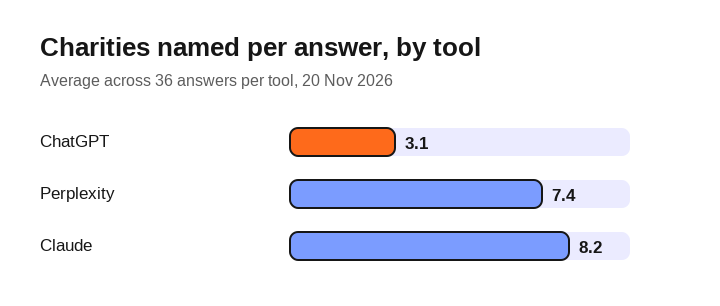
This matters because a charity can do well in one tool and barely appear in another. If your team only checks ChatGPT, you are looking at a narrow slice, and because ChatGPT gives the shortest lists it is also the hardest of the three to get into.
Where the answers come from
Most answers cited sources, meaning the websites the tool read to build its answer. These show which sites the tools rely on for charity questions.
The most cited source by a long way was the ACNC charity register, cited in 44 of the 108 answers (41%). After that came GoFundMe (18%), The Life You Can Save (15%) and YouGov’s charity rankings (11%). Charities’ own websites were cited too, but mostly when the question was about their own cause. UNICEF’s site, for example, was cited for questions about children or international aid.
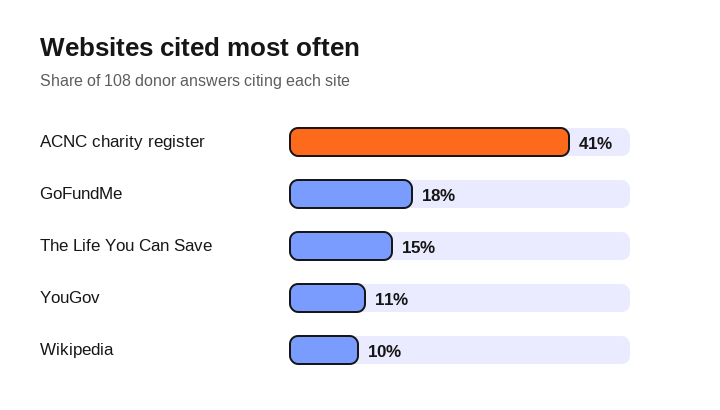
When a donor asks for a recommendation, the tool is choosing between charities, and in our test it leaned on third-party sources such as the regulator’s register, evaluators, rankings and giving platforms more than on any one charity’s own claims about itself. What other sites say about your charity matters as much as what your own site says, particularly for broad questions like “best health charities”. That is a big enough topic for its own post: why AI keeps recommending the same few charities.
What this means for your charity
If you market a charity, this is how we’d use these results. For the wider picture of how we approach search for not-for-profits, see our not-for-profit marketing page.
Work out which questions you should own. List the donor questions where your charity is a natural answer: your cause, your region, your appeals, and the moments when people give, such as Christmas, tax time or a gift in a will. That list is your target, rather than “AI” in general.
If you’re a smaller charity, go narrower. You are unlikely to be named for “best charities in Australia”, and you don’t need to be. Questions about a specific condition, a specific group of people or a specific state are where a smaller charity can realistically be the clear answer, because there are fewer organisations competing for them.
Check whether you’re the answer. Ask each question in ChatGPT, Perplexity, Claude and Gemini, three times each, and note where you appear and where you don’t.
Make the connection obvious. For each question you want to own, make sure your site has a page that answers it directly. If you run a Christmas appeal, the page should say plainly what it is, who it helps and how to give.
Fix your ACNC entry. Because the register was the most cited source in our test, it is worth reading your own entry the way a donor would. The programs you report in your Annual Information Statement appear on the public register, with each program’s name, the type of work it does, who it aims to help and where it operates (see the ACNC’s Annual Information Statement guide). You can list up to 10 programs, so use them. “We support communities in need” gives a tool nothing to match to a donor’s question. “We run breakfast programs in 40 Queensland primary schools” does.
Run this test on your own charity in 20 minutes
You don’t need special tools to start.
- Write down eight to ten questions a donor might ask where your charity should be the answer. Use the donor’s words, not your internal language.
- Ask each one in ChatGPT, Perplexity, Claude and Gemini, in a private or logged-out window so your own history doesn’t affect the answers.
- Ask each question three times in each tool.
- For each answer, note whether your charity is named, which other charities are named and which websites are cited.
- For each question, count how many answers named you out of the total. That is your baseline to compare against next quarter.
If you’d rather we did it, our free AI visibility check runs this across the main AI tools and shows where you’re missing.
Limits of this test
This was one test on one day in three tools. AI answers change often, and a test next month will give different numbers, which is part of the point.
Gemini and Google’s AI Overviews are not included. Both are built on Google Search, so results there will probably differ again.
We counted charities against a fixed list of about 70, so a charity outside that list could have been named without being counted. Several answers mentioned organisations such as Foodbank that we didn’t track.
We work with some of the charities named, as noted above. We didn’t change or filter any answers, and every charity the tools named is counted.
We asked 12 questions. Real donors ask thousands of variations, and the answers would change with the wording.
The 12 questions we asked
- What are the most trusted charities in Australia?
- What are the best charities to donate to in Australia?
- Which Australian charity should I donate to at tax time?
- Which charities make the biggest difference per dollar donated in Australia?
- Which charity should I set up a monthly donation with in Australia?
- What are the best charities to donate to at Christmas in Australia?
- What are the best children’s charities in Australia?
- What are the best health charities to donate to in Australia?
- What are the best animal charities in Australia?
- What are the best international aid charities in Australia?
- Which Australian charities should a company partner with?
- What are the best charities to leave a gift to in my will in Australia?