

When someone in Sydney, Melbourne, Brisbane or anywhere else in Australia needs a lawyer, they often search something like “family lawyer near me” or “employment lawyer Melbourne” and look at the three firms Google shows on the map. If your firm isn’t one of those three, most of those people never see you. This guide explains, in plain English, why that happens and what Australian law firms can do about it. You can do most of it yourself.
If you want the bigger picture first, our page on law firm marketing covers how the map fits with Google Ads, SEO and AI search.
The short answer: 9 steps
- Choose the most specific primary category, like “Family law attorney”, not just “Lawyer”.
- List each practice area as a service on your Business Profile.
- Make sure your office is a real, staffed location. Virtual offices aren’t allowed.
- Use the exact same firm name, address and phone number everywhere online.
- Ask every client for a review, steadily, and reply without confirming they were a client.
- Post on your Business Profile every week or two, and add real photos of your office and team.
- Build a page on your website for each office and each practice area.
- Add local business schema (code that tells Google who you are and where).
- Track your ranking across your area, not just from your own desk.
Why your firm isn’t showing on the map
Google says local results are based mainly on three things: relevance (how well your profile matches the search), distance (how far you are from the person searching) and prominence (how well known your firm is, including reviews and links). There’s no way to pay for a better position on the map. Google explains this in its guide to how local ranking works.
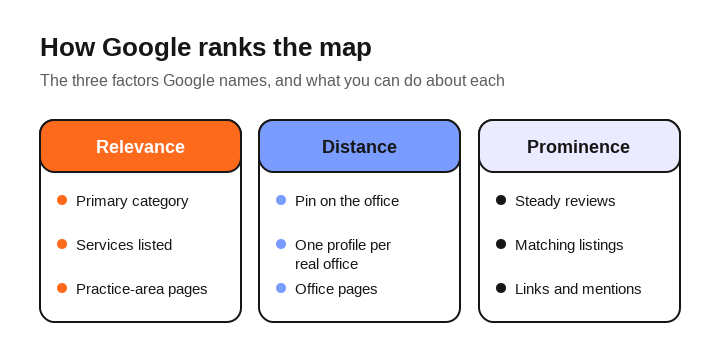
In practice, most law firms that don’t show up have one of three problems. Their profile is vague, their details don’t match across the web, or they have far fewer recent reviews than the firms around them.
1. Category: tell Google exactly what you do
Your primary category is the strongest relevance signal you control. Pick the most specific one that fits your main work, such as “Family law attorney”, “Employment attorney” or “Estate planning attorney”, rather than the general “Law firm”. Google’s category list uses American terms, so you’ll see “attorney” rather than “lawyer”. Google asks businesses to use as few categories as possible and to make them as specific as possible (see its Business Profile guidelines).
2. Services: list every practice area
Add each practice area as a service, with a short plain-English description. Someone searching “de facto property settlement” is more likely to see a firm that lists it.
3. Distance: the factor you can’t fake
Google favours firms close to the person searching. You can’t move your office, but you can:
- Make sure your pin sits exactly on your office.
- Create a separate profile for each real, staffed office. A Parramatta office and a CBD office should each have their own.
- Build an office page on your website for each location.
What you can’t do is list a virtual office or a mailing address. Google says these aren’t eligible for a Business Profile. A co-working office only qualifies if it has clear signage and is staffed during business hours. Firms that break this rule risk having their profile suspended. Our local SEO for lawyers service handles multi-office set-ups like this.
4. Name, address and phone: make them match everywhere
Use the same firm name, address and phone number on your website, your Business Profile and every directory listing. In Australia, the listings that matter for law firms include your state’s law society directory (such as the Law Society of NSW, the Law Institute of Victoria or the Queensland Law Society), legal directories, Yellow Pages and True Local.
Don’t add keywords to your firm’s name on Google, like “Smith Lawyers – Best Divorce Lawyer Sydney”. Google doesn’t allow it, and it can get your profile suspended.
5. Reviews: steady, honest and confidential
More reviews and better ratings help your ranking, and Google notes that replying shows clients you value their feedback. For law firms, there are two extra rules:
- Ask every client, not just the happy ones. Never offer anything in return, and never write or buy reviews. Google removes them, and they can mislead potential clients.
- Protect confidentiality in replies. Don’t confirm that the reviewer was a client, and never mention their matter, even when the review is unfair. Thank them, or invite them to contact the office.
A steady stream of reviews each month looks more natural, to Google and to the people reading them, than a burst of 20 in one week.
6. Posts and photos: show the profile is looked after
A potential client often checks your Google profile before they call. If the last update was two years ago, they may wonder whether anyone is minding the shop. Regular posts show the firm is active and that there are real people behind it, which builds trust before the first conversation.
Aim for a post every week or two. Ideas that work well for law firms:
- A plain-English explainer on a recent change in the law
- An answer to a question clients often ask, like “What happens to the house in a separation?”
- Firm news: a new lawyer, a new office, extended hours
- Community involvement, events or seminars
Keep every post within your conduct rules. Never mention a client or their matter, avoid promising outcomes, and don’t describe anyone as a specialist unless they’re accredited.
Add real photos too: your office, the entrance and signage (so people recognise it when they arrive) and your team. Stock images do little to build trust. Keep your hours, including public holidays, up to date as well. Out-of-date details are one of the quickest ways to lose a potential client.
7. Website: one page per office, one page per practice area
Your Business Profile links to your website, and Google reads both. A page for each office (with the address, a map and the practice areas handled there) and a page for each practice area give Google a clear match for searches like “wills lawyer Castle Hill” or “family lawyer Box Hill”. Our guide to local SEO goes into more detail on location pages.
8. Schema: label your details for Google
Local business schema is a small piece of code on your website that tells Google your firm’s name, address, phone, hours and practice areas in a format it reads easily. Most web developers can add it quickly.
9. Grid tracking: see what clients actually see
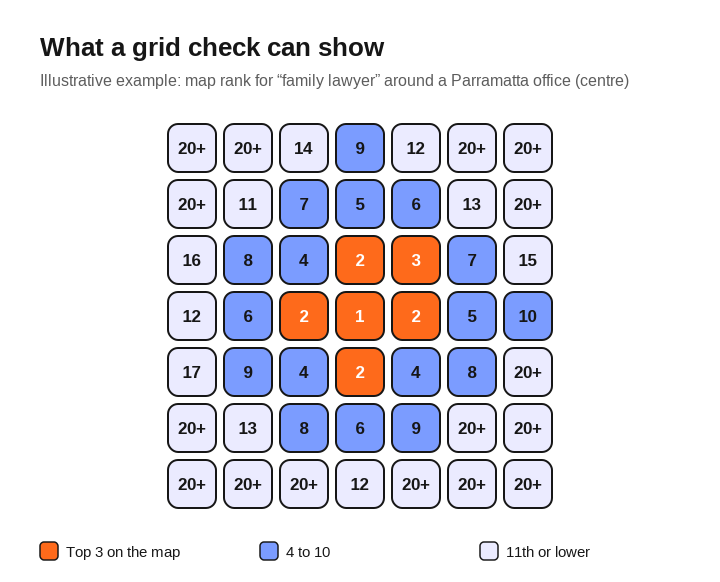
Searching from your own desk gives you a misleading picture, because you’re right next to your office. A grid tracking tool checks your map ranking from dozens of points across your area, so you can see where you show up and where you drop off. It’s the most reliable way to tell whether your work is paying off.
What a grid tracking check looks like
Imagine a family law firm in Parramatta. Searched from its own office, it’s first on the map. A grid check across the area could tell a different story: top three within about a kilometre of the office, fifth or sixth a few suburbs away, and not on the map at all near Blacktown or Castle Hill. That isn’t a sign something is broken. It’s distance at work, and it shows where office pages and Google Ads need to pick up the slack.
Mistakes that get a law firm’s profile suspended
- Listing a virtual office or a mailing address
- Adding keywords or suburbs to the firm name
- Creating extra profiles under the firm’s name at the same address (individual lawyers can have their own profile, but it must be in their own name, not the firm’s)
- Buying or swapping reviews
A suspended profile disappears from the map, and getting it back can take weeks.
Want a second opinion on your profile?
If you’d rather not do this yourself, or you’re not sure what’s holding your firm back, our Sydney team is happy to help. We’ll review your Google Business Profile and tell you honestly what to fix first. No obligation, no jargon. See local SEO for lawyers, or ask for a free audit.