
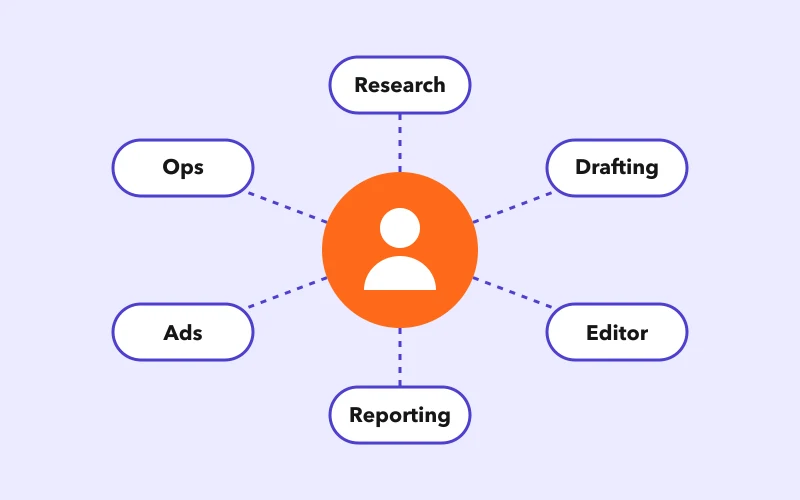
An AI marketing team is a set of AI marketing agents, each with one narrow job, working from shared company knowledge and checked by people. It can take a lot of the legwork out of marketing. It cannot be left to run on its own.
We know because we build and run one at our Sydney agency. We work with firms in law, finance and professional services, where a wrong claim is costly. This guide covers which agents to consider, the layers that hold the system together, and the mistakes our own checks caught in a single week.
Key takeaways
- Agents are the easy part. The knowledge, rules and checks around them are most of the work.
- Feed the system real examples, real numbers and real case studies. The more real context it has, the better the work.
- Every output needs a check by another agent, and a person signs off anything that gets published, sent or spent.
- Use a second AI model as a reviewer. A model tends to miss its own mistakes.
- Start with one workflow and review everything. Widen it only when the checks hold.
What is an AI marketing team?
It is not one chatbot doing everything. It is several AI agents, each set up for a single task, such as research, drafting or reporting. They hand work to each other in a fixed order. People set the goals, check the output and make the calls that carry risk.
The idea is simple. The build is not. Most guides stop at "set up some agents". In our experience the agents are the smaller part of the work. Most of it is what sits around them.
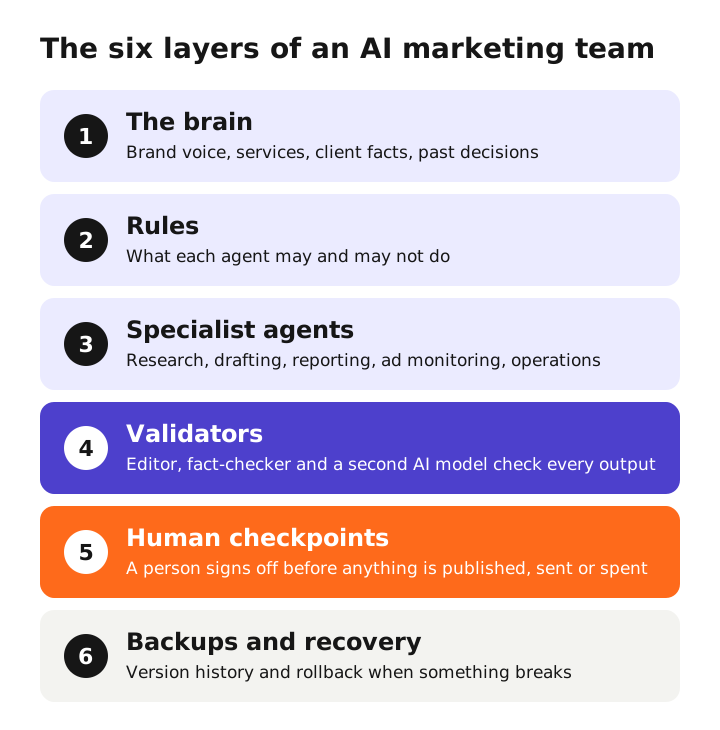
The six layers of the system
1. The brain
This is the shared knowledge every agent works from: brand voice, services, client facts, approved results and past decisions. Some people call it a company operating system. Without it, each agent fills the gaps with guesses, and the guesses sound confident.
It has to be one brain for the whole team, not one per person. When each person teaches their own AI account, each person gets a bit faster, but the business learns little. Say one person agrees to pause a campaign, and a colleague's AI recommends raising its budget an hour later, because nobody told it. With one shared brain, every person and every agent reads from the same place. Approved changes are saved back to it. A decision made once is available to everyone, as long as someone records it.
What you put in decides what you get out. The most valuable inputs are real ones: actual results, real numbers from your accounts, case studies, examples of work you were happy with, notes on what went wrong, and what your competitors are doing. An agent given generic instructions writes generic work. An agent given your real experience writes something close to what you would have written.
The brain also needs constant review. Facts go stale. A rate changes, a client leaves, a service is dropped. If nobody updates the brain, the agents keep working from the old version.
2. Rules
Rules say what each agent may and may not do. Ours include: never invent a figure, only quote results from published case studies, never state a price, and never publish, send or spend without approval. Write them down plainly and give them to every agent.
Rules also cover people. Decide who can see what, and who is allowed to change the brain. Not everyone needs client financials, and a new starter should not be able to rewrite a policy. Give each person and each agent only the access their job needs, and have a senior person approve changes to the rules and the core facts. For law and finance clients, this can also be a confidentiality issue.
3. Specialist agents
Give each agent one job. A narrow agent is easier to brief, easier to check and easier to fix. These are the AI agents for marketing worth considering first.
| Agent | What it does | Where it goes wrong |
|---|---|---|
| Research | Pulls keyword, competitor and account data from real tools | Fills gaps with plausible numbers if a source is missing |
| Drafting | Writes posts, ads and emails from a brief | Repeats old or unsourced claims it finds in existing copy |
| Editor and fact-checker | Checks facts, tone, compliance and house style | Can review the wrong version, or pass a claim that only sounds right |
| Ad monitoring | Watches spend, search terms and tracking for problems | Flags noise, or misses a problem in how conversions are counted |
| Reporting | Turns account data into a plain summary | Reports the numbers it is given, even if the tracking behind them is broken |
| Operations | Sorts enquiries, drafts follow-ups, keeps task lists current | Treats spam as a lead, or a lead as spam |
4. Validators
A validator is an agent whose only job is to check another agent. We use an editor and fact-checker on everything. Then we use a second AI model from a different provider as a cold reviewer. It has not seen the brief or the drafting, so it reads the work the way a stranger would.
Validators need checking too. More on that below.
5. Human checkpoints
This is what people mean by "human in the loop". A person approves the work at fixed points. For us that is before anything is published, sent to a client, or changes what an account spends. The person needs enough experience to know when something is wrong. A checkpoint staffed by someone who cannot spot the error is not a checkpoint.
6. Backups and recovery
Things will break. Keep version history for everything the agents touch, and make sure you can roll back in one step. Run automatic checks on every update, so a broken version is blocked before it goes live.
How work moves through the team
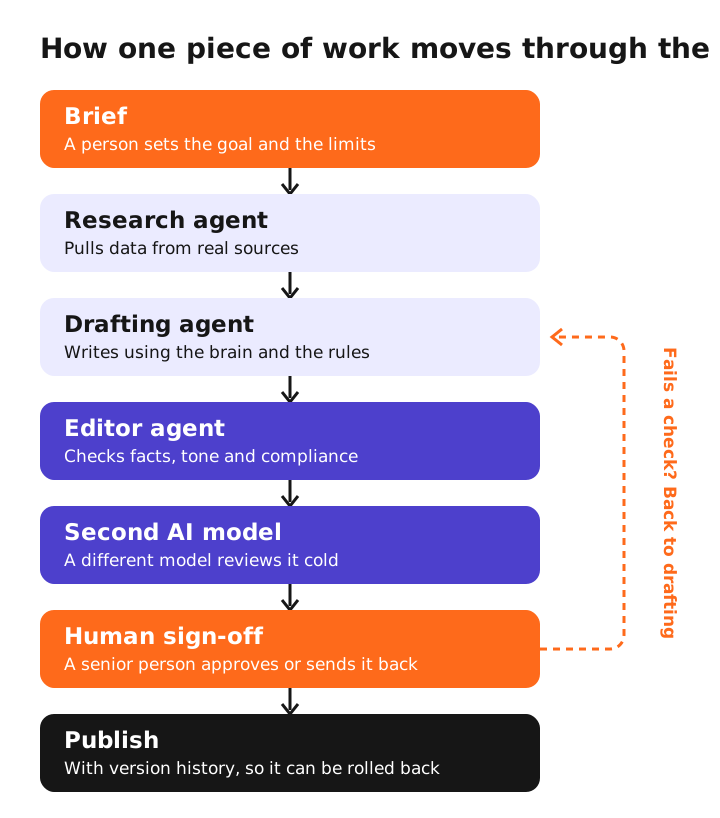
It sounds slow. It is still faster than doing every step by hand, and the checks are where the quality comes from.
What our checks caught in one week
We recently used this system to refresh a batch of older posts on this blog. Here is what the checks found. None of it is unusual. This is what working with AI looks like, and it is why we check.
- Cost figures with no source. An older post, written before we had these checks, quoted legal click costs we could not trace to a source. We replaced them with Google's own Keyword Planner figures for Australia and named the source.
- A closed programme, still recommended. An older charity guide still recommended AmazonSmile, which Amazon closed in February 2023. The guide has been rewritten.
- A reviewer reading the wrong page. We gave a second AI model three live links to review. It reviewed old cached copies, twice, and flagged errors we had already fixed. It also reported a calculator as missing when it was live. Pasting the page text in directly fixed it.
- A reviewer inventing numbers. The same reviewer suggested we add a benchmark table, and supplied figures with no source. We did not use them.
- A wrong definition. A draft described Google's bid estimates incorrectly. The editor agent checked Google's own help page and corrected it.
- Our own brand listed as a client. A draft put a result from a brand we own next to client results. The editor agent flagged that it could confuse readers, and we relabelled it as our own brand.
- A change that would have broken two pages. We removed eight old posts. Two other pages still pointed to them. The automatic check failed, so the broken version never went live.
Any of these could have been published by a system with no checks. Several were caught by AI. All of them needed a person to decide what to do next. We wrote more about this in our honest review of using Claude for SEO.
Want this level of checking on your Google Ads or SEO? Talk to a senior specialist at One Egg.
What to hand over and what to keep
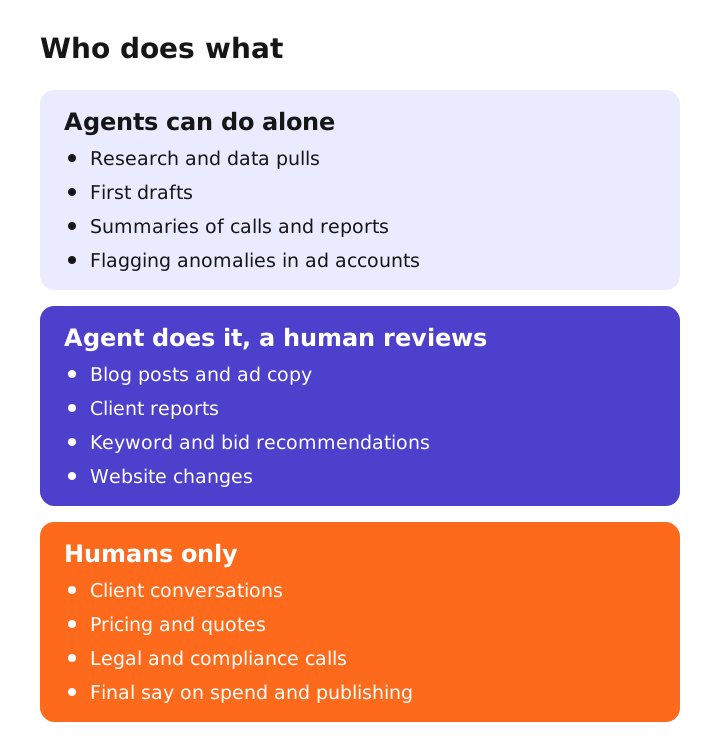
Low-risk work that is easy to check can go to agents. Anything a client or the public will see gets a human review. Some things stay with people: client conversations, pricing, legal and compliance calls, and the final say on spend.
Drafts stay internal until a person has reviewed them.
The test is simple. Ask what happens if the agent is wrong and nobody notices. If the answer is "a draft needs fixing", hand it over. If the answer is "a client gets bad advice", keep a person on it.
Why you cannot rely on AI 100%
- It states wrong things with confidence. A made-up figure reads exactly like a real one.
- It copies old mistakes. If a claim is already on your site, a drafting agent will often reuse it.
- It often does not know what has changed. Programmes close, rules change and features differ by country.
- It cannot be accountable. If a claim is misleading, the business that published it answers for it, not the tool.
The stakes are higher in regulated work. In Australia, a misleading claim can breach the Australian Consumer Law. Law firms also have advertising rules to follow, and financial promotions are regulated by ASIC. An unchecked AI draft does not know any of that.
None of this is a reason to avoid AI. It is a reason to build the checks first, and to keep a person in the loop for good. The review never finishes. Tools change, your business changes, and the system has to be kept on point.
Is client data safe in AI tools?
It depends on the tool and the plan. Read each provider's data terms before you use it. Check whether your inputs are used to train models and where the data is stored. Keep confidential client information out of free consumer tools. Give each agent only the data its job needs. If you work in law or finance, check your obligations under the Privacy Act 1988 and your industry conduct rules before connecting any client data.
How to start small
- Pick one workflow. Choose something repeated and low risk, like first drafts of reports.
- Write the brain for that workflow. One page of facts, voice and approved numbers is enough to start.
- Write five rules. Start with "never invent a figure" and "never publish without approval".
- Add one validator. Have a second agent check every output against the brain and the rules.
- Review everything yourself for a month. Log every error and turn each one into a rule.
- Then widen it. Add the next workflow only when the first one is boring, and budget ongoing senior time to keep the rules current as models change.
Build it yourself, or use an AI marketing agency?
You can build this yourself. Plan for real time: writing the brain, setting rules, testing validators, and keeping it all current as tools change. You also need someone senior enough to catch what the agents get wrong. That is the part people underestimate.
The other option is to work with an AI marketing agency that already runs this kind of system. That is how we work at One Egg. Agents do the legwork. Senior specialists check the work and make the calls on every account. We work with law firms, financial services and professional services firms, where accuracy matters. You get the speed without having to build and maintain the system.
If you want that for your SEO, AI search or Google Ads, book a strategy call. A senior specialist will review your current SEO, AI search visibility or Google Ads, and show you what this would look like for your firm.